
California ADU Insurance: What Changes When You Build or Rent a Backyard Home?
Building or renting an ADU in California? Compare dwelling limits, rental liability, construction coverage, wildfire options, and quote details before assuming your home policy extends.
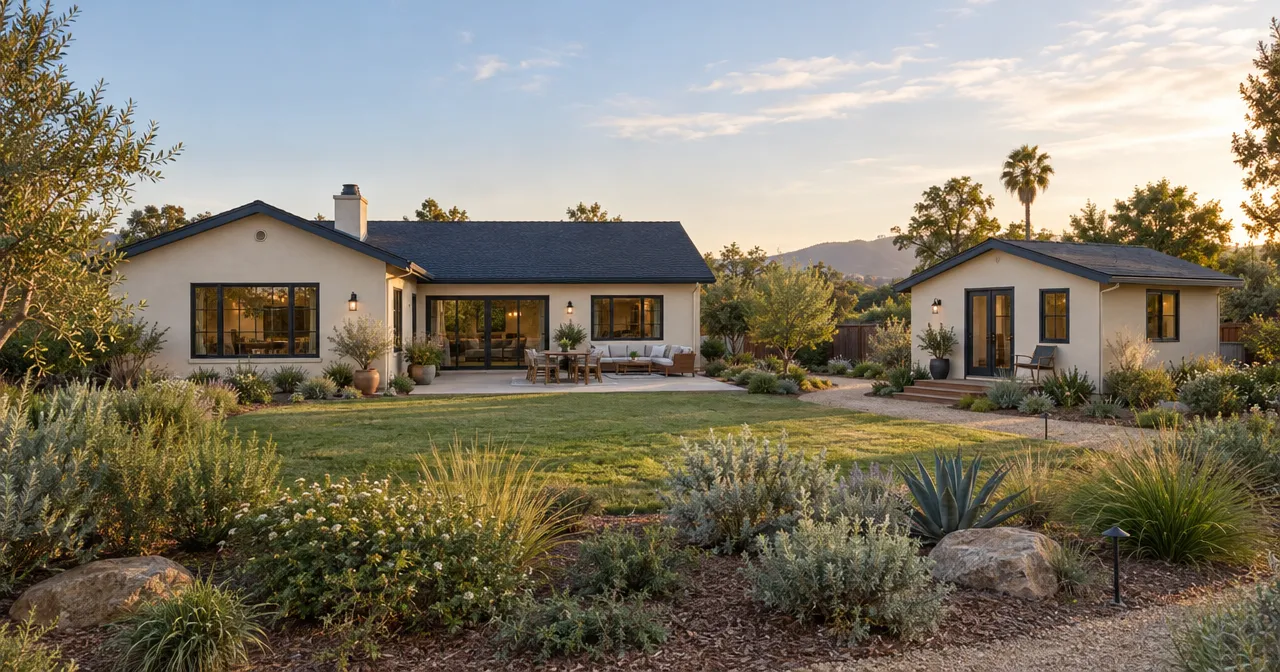
A backyard cottage can change a property in ways a home insurance declarations page does not immediately show. The building may be detached from the house, a garage may become living space, or an attached addition may have its own entrance and tenant. Those distinctions matter when an insurer estimates rebuilding costs, sets limits for other structures, and evaluates liability and rental use.
If you own a home in Mission Viejo, the Bay Area, San Diego, or Los Angeles and are planning an accessory dwelling unit (ADU), the most useful insurance question is not simply “Does my homeowners policy cover an ADU?” It is which policy covers this particular structure, during which stage, for which use, and up to what amount? Answer that before work begins and again before anyone moves in.
First describe the unit accurately
California’s Department of Housing and Community Development ADU resources discuss ADUs and junior ADUs as distinct housing arrangements. For an insurance review, the label alone is less useful than a plain description of what is being built or converted. Tell the insurer or agent whether the space is attached to the main house, detached, or converted from a garage; its square footage and materials; whether it has a kitchen or bathroom; and how it will be occupied.
Consider three different properties:
- A Mission Viejo homeowner converts an attached garage into a unit for a parent. The improvement may change the cost to rebuild the main dwelling, even if no rent changes hands.
- A Bay Area homeowner builds a separate backyard cottage and leases it for a year. The insurer needs to evaluate the detached building and the tenant occupancy, not just the original house.
- A Los Angeles owner offers a separate unit for short stays. That use can raise different underwriting and liability questions from a long-term lease; do not assume a platform’s protection replaces a policy written for the actual arrangement.
These examples are prompts for discussion, not declarations that one specific endorsement or policy will work. Carrier forms and eligibility rules differ. Keep the permit plans, construction specifications, final square footage, and occupancy details together so every quote starts from the same facts. Permitting and insurance are separate issues: a permit does not automatically amend a policy.
Before construction: ask when coverage begins
Contact your insurer or agent before demolition or construction, not only when the unit is finished. Explain whether you are adding a structure, converting a garage, or connecting new work to the house. Ask what the existing policy would cover during the project, whether construction-related losses are restricted, and whether a separate construction or builder’s-risk arrangement is needed. Also ask how materials on site, theft, weather damage, and the property’s occupancy will be treated. Do not assume a contractor’s insurance covers your building or every loss to it; request the contractor’s insurance details and have the roles explained.
A temporary vacancy or a move out of the main home can matter as much as the project itself. Tell the insurer if you will leave the property or move into the ADU while the original house is renovated. Get any change in coverage, limits, deductibles, and effective dates in writing. The California Department of Insurance (CDI) residential insurance guide advises homeowners to discuss modifications and keep records of renovations when reviewing dwelling limits.
At completion, send the final specifications and occupancy date to the insurer. An estimate based on early drawings may no longer reflect a larger footprint, upgraded fixtures, or different construction materials. Photograph the finished space and retain invoices and permit documents so the rebuild estimate can be checked against what actually exists.
Attached versus detached: find the right building limit
A conventional homeowners policy distinguishes Coverage A, the dwelling and attached structures, from Coverage B, other structures not attached to the dwelling. CDI says Coverage B is normally limited to 10% of Coverage A, though more may be available for an additional premium. That general pattern is not a promise that your detached ADU fits the form or that the default limit is enough, especially if it is rented.
Here is a simple illustration. If the main dwelling limit is $800,000, a 10% other-structures limit would be $80,000. If the estimated cost to rebuild a detached ADU is $240,000, that gap requires a conversation about how the unit is insured and what limit should be assigned. The figures are hypothetical, not a quote or an estimate of California ADU construction costs. Other detached structures may share the same limit, and policy terms can limit or exclude particular uses.
For an attached conversion, ask whether the added square footage, plumbing, electrical work, and finishes are reflected in the dwelling replacement-cost estimate. For a detached unit, ask whether it is specifically described and covered under the applicable policy or endorsement, whether it has a separate limit, and whether any other-structures limit applies. A structure’s market value or the amount you borrowed to build it is not the amount needed to rebuild it. CDI recommends basing dwelling limits on the cost of labor and materials rather than land or sale value.
Look beyond the headline limit. Compare replacement-cost versus actual-cash-value settlement, any roof provision, ordinance-or-law coverage for code upgrades, debris removal, and extended replacement cost if available. An endorsement may add protection but may also impose conditions. A high deductible can change the value of a quote: a 2% deductible applied to a $900,000 building limit would be $18,000 if that is how the policy defines the percentage. Confirm which building limit and cause of loss the deductible applies to; the illustration is not a typical quote.
When someone lives there: separate the owner’s risk from the resident’s
An ADU for family use and an ADU rented to a tenant do not present identical exposures. Disclose whether the occupant is family, a long-term tenant, or a short-term guest. Ask whether the proposed homeowners or landlord arrangement covers injury claims involving the unit or shared spaces, and whether any personal umbrella policy accepts the rental exposure and the underlying liability limits. An umbrella is not a substitute for the correct property or liability policy beneath it.
If a tenant occupies the unit, distinguish your building and landlord-owned fixtures from the tenant’s belongings. CDI’s residential guide notes that a landlord does not insure a renter’s personal property; a tenant can consider renters insurance for belongings, loss of use, and personal liability. If you provide furniture or appliances, ask where those owner-owned items appear in your policy. Do not presume your own contents limit covers everything in a rented ADU.
Two terms are easy to confuse after a covered loss. Additional living expense coverage concerns the owner’s extra costs if a covered event makes the insured residence uninhabitable, subject to the policy’s conditions. Fair rental value or loss of rents, when included, concerns rental income lost because covered damage makes a rented unit unusable. Ask separately whether each applies to the main house and ADU, what event triggers it, and how long it lasts. Neither is a blanket promise to reimburse every mortgage payment or every night the property cannot be marketed.
If the unit becomes a home office, short-stay rental, or workspace for a business, review that use before it begins. A standard personal policy may have limits or exclusions for business property and activities; a business owners policy or other commercial coverage may be relevant depending on the operation. Likewise, do not assume personal auto coverage applies to a vehicle used as part of a rental or business service. Keep the insurance discussion tied to what you actually do, not the general description “home with ADU.”
Wildfire, nonrenewal, and the FAIR Plan path
A new ADU does not make a hard-to-place property easier to insure automatically. If the home is near brush or in a wildfire-exposed area, ask how both the main dwelling and the unit affect eligibility, replacement-cost estimates, and any mitigation documentation. CDI’s Safer from Wildfires guidance discusses measures such as a Class-A roof, ember-resistant vents, and the immediate area around a structure. Ask the carrier what evidence it wants; a mitigation project should not be treated as a guaranteed offer or renewal.
If you receive a nonrenewal while planning or operating an ADU, start the replacement search early and provide accurate occupancy information with each application. Shieldly’s separate home insurance nonrenewal guide covers notice timing and a broader shopping timeline. Here, the additional task is to confirm the unit’s building limit and rental use on each proposed replacement policy before the existing coverage ends.
The California FAIR Plan describes its dwelling policy as named-peril coverage and lists owner-occupied and certain rental occupancies among its property types. Its basic listed perils include fire, lightning, internal explosion, and smoke, with some optional coverage at additional cost. That does not mean every ADU configuration is automatically accepted or fully covered. Ask a broker to submit the exact layout and use, and check the written offer for the main home, detached unit, other structures, contents, rental-value terms, and limits.
A separate difference-in-conditions (DIC) policy may address selected gaps such as water damage, theft, and liability; the FAIR Plan itself does not sell DIC. Review the two policies together: which policy covers which building, which occupancy it recognizes, whether liability extends to a rented unit, and whether the effective dates line up. A FAIR Plan policy plus a DIC policy is not automatically equivalent to every standard homeowners policy. Flood and earthquake require their own review as well; CDI says they are generally excluded from a typical homeowners policy.
Compare ADU quotes on the same assumptions
AI applications and online comparison tools can be useful for generating a first set of options, but a short online form may not capture a converted garage, detached tenant-occupied cottage, construction phase, or wildfire underwriting details. Treat an on-screen premium as a starting point until the insurer confirms eligibility, policy forms, and bindable terms. A licensed-agent review is particularly useful when two quotes use different occupancy classifications or put the ADU under different building limits.
Use this compact comparison worksheet for each option:
| Detail | What to verify in writing |
|---|---|
| Property description | Is the unit attached, detached, or converted; what is its square footage; and is it listed on the application and policy? |
| Occupancy | Does the insurer know whether a relative, long-term tenant, short-term guest, or nobody will live there? |
| Building limits | What are the main-home and ADU limits, and is the ADU included in Coverage A, Coverage B, a separate schedule, or another policy? |
| How losses are paid | Replacement cost or actual cash value? Any roof, code-upgrade, or extended-replacement-cost terms? |
| Out-of-pocket cost | What deductible applies to each covered peril and building, and is any deductible a percentage? |
| Income and displacement | Is fair rental value included for the ADU? What additional living expenses apply to the owner’s residence? |
| Liability and exclusions | Does liability cover the disclosed occupancy and shared areas? Are any water, theft, wildfire, flood, or earthquake gaps left? |
| Start date and status | Is this a preliminary estimate or an approved offer? When do construction and permanent coverage actually begin? |
Compare the combined cost of any required policies and endorsements, not just one premium. A lower-priced offer with an $80,000 other-structures limit where the ADU needs a materially larger rebuild limit is not the same product as an offer that properly schedules the unit. Equally, an expensive policy is not necessarily well matched if it misstates how the unit is used. Ask for revised quotes with consistent inputs, then review the forms and declarations rather than relying on a summary screen. If you already have an AI-generated proposal, Shieldly’s AI Quote Check can help identify assumptions to verify with a licensed agent.
A short handoff checklist
Before requesting quotes, gather your current declarations page, the proposed or final plans, square footage and construction details for both buildings, the planned occupancy and lease length, photos, any wildfire mitigation records, and the date work starts or residents move in. If there is already a nonrenewal notice, include its expiration date. Ask the agent to return a written comparison of the building limits, covered perils, liability, deductibles, rental-value terms, and any separate policies needed.
An ADU can be a useful family space or a rental home, but its insurance needs to reflect the structure and the way it is used. Contact Shieldly for a detailed policy review or side-by-side quote comparison. The agency can help California homeowners use convenient policy-import and comparison tools while getting a careful explanation of what each option protects—and what still needs an answer.